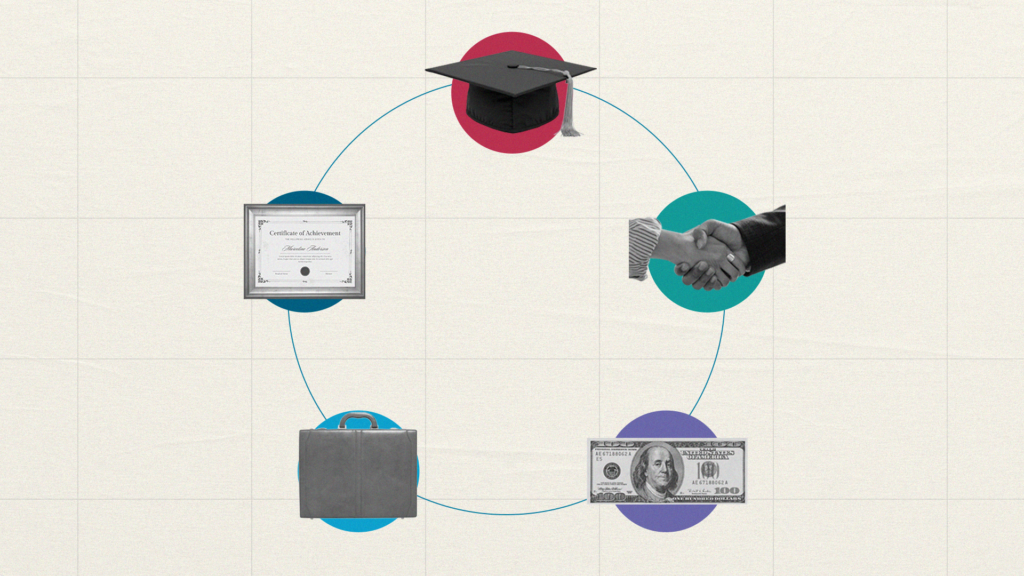
The ROI conversation in higher education runs on short-term metrics: enrollment, completion, first hiring, early salary data. Those numbers are useful. They are also incomplete.
They persist for practical reasons. Accreditation systems, employer scorecards, and state accountability structures reward what is easy to count quickly. Institutions report what they are asked to report, and over time, what gets reported becomes what gets valued.
That dynamic shapes more than measurement. It shapes what gets built. The institutions that recognize this earliest will not just make a stronger case for their programs. They will design programs worth making the case for.
Value Over Time
A better ROI model looks further. Where is the learner three or five years out? The questions that follow from that shift:
- Did the learner move into a better role within three to five years and beyond?
- Did the credential help them change fields or advance internally?
- Did income stabilize or rise across a longer window?
- Did the program make them more adaptable in a changing labor market?
A program worth its cost reveals itself in where a learner is five years out, not just where they land on day one.
The Program Design Problem
Measurement and design are not separate problems. What an institution chooses to track shapes what it builds, and what it builds determines what it can honestly claim to deliver.
Institutions that reward quick placement and early wage gains will naturally build offerings aimed at those outcomes. The incentives in place make that a logical response, and those incentives were never designed with career-long progression in mind.
Shifting the measurement arc changes the design question. Instead of asking what credential gets a learner hired, the question becomes what sequence of learning keeps a learner advancing.
Those are different programs that require a different kind of thinking on the front end: a reflective look at what outcomes you are actually trying to produce, what data would tell you whether you are producing them, and whether your current offerings are structured to get there.
That work is harder than adding a tracking dashboard. It is also where the real leverage is. In fields being reshaped by AI and automation, a program’s value may lie precisely in its ability to help learners keep pace with change. That value will not show up in first-year placement data. It has to be designed for.
The Opportunity for Continuing Ed
The institutions best positioned to adopt a long-view ROI model are often community colleges and regional universities. They serve learners who are career-focused and price-sensitive, enrolling for practical reasons rather than prestige. They also have something larger research universities rarely do: proximity. Their employer partnerships and regional labor-market knowledge put them in a position to see whether graduates are actually advancing in nearby industries, not just whether they got hired.
That proximity also gives these institutions a stronger case to make. Families want to know whether a program will still be paying off in five years. Employers want to know whether a credential signals genuine capability or just completion. A program that can point to wage growth, internal advancement, or a successful career transition speaks directly to both audiences. That is a more durable value proposition than placement rates alone can offer.
A Design-First Model
When Eastern Millwork, a New Jersey manufacturer of high-end custom woodwork, needed a pipeline of skilled workers, traditional degree graduates were not meeting the need. The company approached Hudson County Community College, and HCCC’s response was to start from scratch. Rather than fitting the employer’s needs into an existing program, the college rethought the educational model entirely, designing a curriculum around what the job actually required and building the learning experience from the outcome back.
The result is the Holz-Technik Apprenticeship Academy, a five-year, tuition-free, earn-while-you-learn program that leads to an associate degree from HCCC, a bachelor’s degree from Thomas Edison State University, and a well-paying career in a high-demand field. The program was designed and launched in seven months. New Jersey’s governor has described it as a blueprint for the state’s economic future, and it has since become a national model for workforce development partnerships.
What makes it instructive is not the speed or the scale. It is the sequence. HCCC did not build a program and then ask whether it produced outcomes. They defined the outcome first and designed the program to reach it.
The New Standard
Proving that education helps learners advance throughout their careers is a more demanding standard than placement rates, and a more credible one. Institutions that adopt it will need to do more than add tracking. They will need to look hard at what their programs are actually built to produce, and whether the design matches the claim.
That is the real shift. Institutions that make it will not just report better outcomes. They will produce them.
Let’s talk.