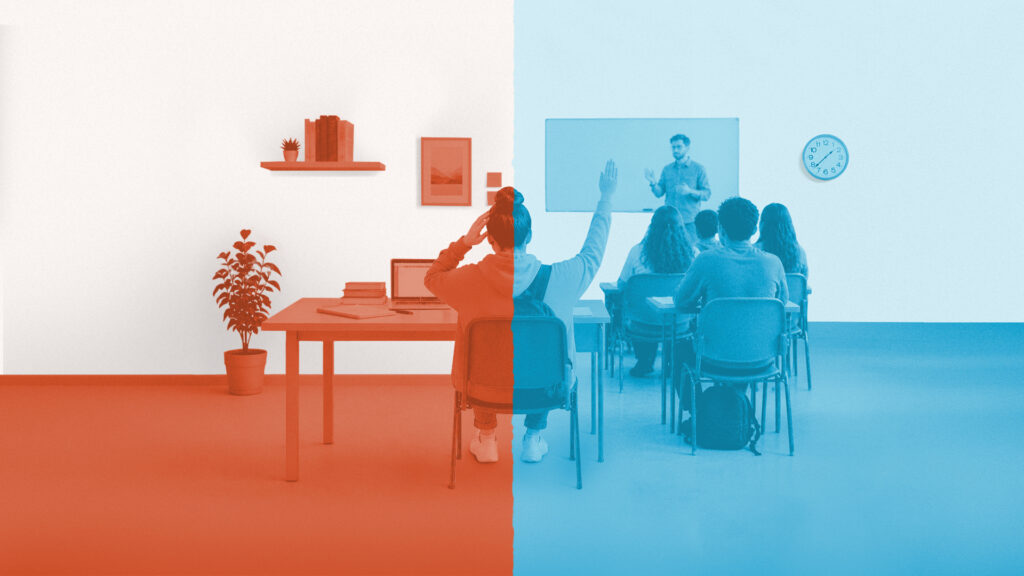


The idea that course delivery defines the learner experience is breaking down.
For years, institutions designed student support around a clear distinction: online learners need one kind of experience, and campus-based learners need another. That model made sense when format reliably reflected how learners engaged, communicated, and accessed support.
That distinction no longer exists.
Today’s learners move fluidly across environments. They submit assignments through digital platforms, message advisors outside traditional hours, and expect support to be accessible regardless of where or when they are learning. When support models remain tied to modality, institutions unknowingly limit their ability to respond in the moments that matter most.
Creating a more connected experience for learners requires a human-centered approach that ensures timely, relevant, and responsive support for what learners actually need in the moment.
When Modality Made Sense
Modality-based infrastructure once created real efficiency. Institutions built specialized advising teams, defined clear communication channels, and tailored workflows to the unique operational needs of online and campus-based programs. These structures were not arbitrary. They reflected learner behaviors that were, at the time, closely tied to modality.
When Modality Stopped Matching Reality
This shift really started with advancing technology.
Learners no longer engage within a single, clearly defined environment. They move fluidly between digital and physical experiences, accessing course materials online, communicating across channels, and seeking support outside traditional hours.
Technology is no longer an add-on for a specific group. It is foundational to how all learners experience their programs.
The New Reality: Modality-Agnostic Expectations
Learners don’t evaluate their experience based on how they’re learning. They evaluate it based on how supported they feel in the moments that matter.
When a question goes unanswered, when outreach arrives too late, or when communication feels generic, learners feel the immediate impact. Progress slows. Confidence drops. Connection weakens.
Scenario: A learner misses an assignment deadline.
- Modality-driven: The response is dependent on which team “owns” the learner and which system registers the signal (e.g., “online” vs. “on-ground”).
- Modality-agnostic: The moment immediately triggers timely, personalized outreach based on the learner’s recent activity and academic progress.
Ultimately, learning modality no longer dictates retention risk. Instead, the responsiveness and relevance of support determine whether a student stays or leaves. A failure to meet learner expectations increases friction, which, in turn, curtails persistence.
What a Modality-Agnostic Support Model Requires
Moving beyond modality-based support doesn’t require rebuilding from scratch. For most institutions, the pieces are already in place. What’s needed is to align them around the learner, not the delivery format.
Always-On, Learner-Facing Support
Learners expect help when questions arise, not when offices open. Technology tools, like AI-enabled chat, enable universities to provide immediate answers, guide next steps, and extend support beyond traditional hours. A learner reviewing financial aid information late at night can get clarity in that moment, while their advisor can be flagged to follow up with the right context when they log on.
The result is a more intentional division of labor: technology handles the immediate, and advisors step in with the context and relationship that only a human can provide.
Unified Visibility Across the Learner Journey
Support cannot be coordinated if signals remain fragmented. A modality-agnostic model integrates engagement data, academic progress, and service interactions into a shared view, allowing advisors and support teams to see what is happening in real time.
With that visibility, support becomes more proactive and more human. Instead of waiting for learners to struggle, teams recognize early signs of risk and respond with outreach that reflects what learners are experiencing.
Coordinated, Timely, and Personalized Outreach
This is where human-centered support becomes most visible. Learners are not left to navigate challenges on their own. When they miss an assignment, stop engaging, or encounter a barrier, that moment triggers timely, relevant, and grounded outreach.
The Impact on Persistence
Learners already operate in a modality-agnostic world. Their expectations are shaped by experiences that are immediate, connected, and responsive.
Institutions that align support with those expectations see stronger persistence, higher satisfaction, and better completion outcomes. Institutions that don’t will continue to experience friction that is difficult to trace and difficult to ignore.
The advantage no longer belongs to institutions with the strongest online programs or the most compelling campus experiences in isolation. It will go to those who deliver consistent, technology-enhanced, human-centered support across the learner journey.
Is your support model built for how learners actually engage today?
Most institutions didn’t design their support systems for a modality-agnostic experience. But that’s the environment learners now expect. If you’re evaluating how your institution delivers support across the learner journey, let us help you identify gaps and design a more responsive model.