
At UPCEA MEMS 2025, we co-presented with Dr. Cody House, Director of Executive & Lifelong Learning at George Washington University’s College of Professional Studies, to ask a simple but powerful question to a room full of marketers, enrollment leaders, and student success practitioners: What would your learner journey look like if every stage were supported by connected AI?
Dr. House leads GW’s RevU, launched in October 2024, the college’s lifelong learning initiative offering microcredentials and industry certifications in homeland security and cybersecurity. Noodle was brought in Fall 2023 to provide the technology solution.
Our session, “AI From Ad to Grad: Enhancing the Student Journey with Connected Agents”, blended a short presentation with an interactive mapping activity. Participants identified Brags (what’s working), Drags (pain points), and Zags (opportunities) across six stages a learner travels:
- Discover – Identifying options aligned with their goals
- Connect – Beginning a relationship with an institution
- Decide – Selecting and committing to a program
- Learn – Engaging in coursework and community
- Succeed – Building momentum toward completion
- Advance – Deepening long-term ties with the institution
What emerged wasn’t just a list of operational challenges,but a composite portrait of where higher ed stands right now: overextended, hopeful, and eager for more coherent ways to support learners across their journeys.
Following is a refined look at what participants surfaced.
Discover: Institutions are trying to modernize… but are still wrestling with the basics.
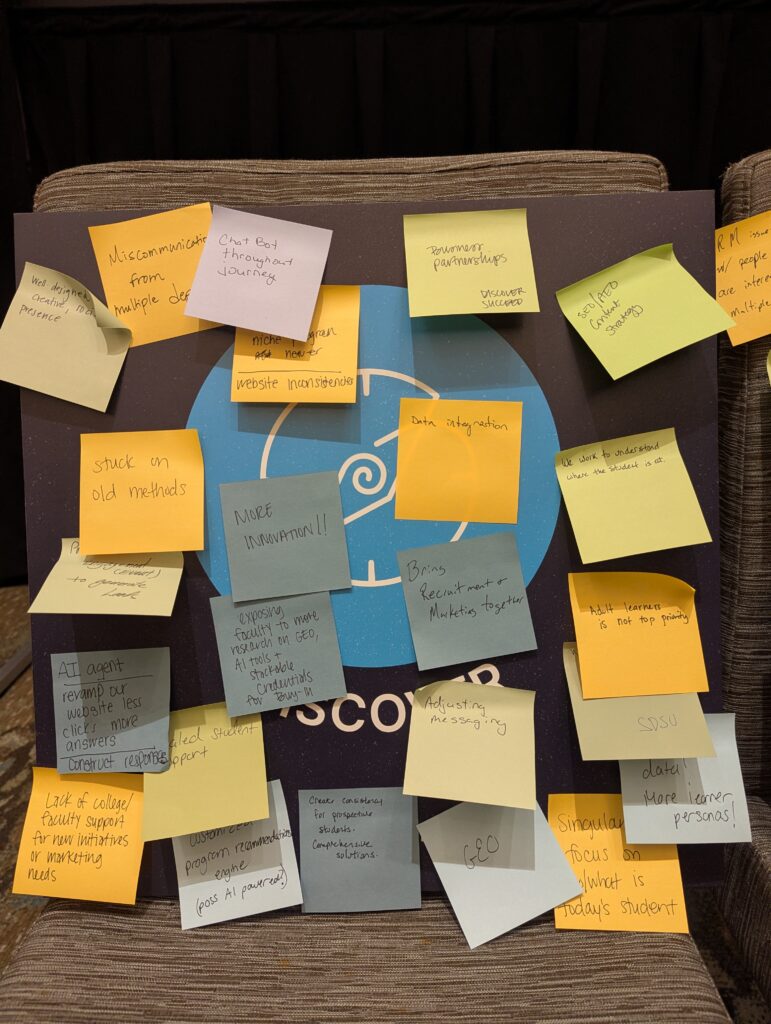
Participants’ Brags centered on meaningful progress—renewed focus on adult learners, early AI pilots, and more intentional storytelling. But their Drags showed a different picture: outdated web experiences, unclear ownership of prospective learners, and data systems that don’t talk to each other.
Many Zags pointed toward innovation in site search, personalization, and more adaptive entry points. The throughline was clear: institutions don’t necessarily need more marketing—they need coherent discovery pathways that respond to learner intent rather than institutional structure.
Connect: The human side of recruitment feels strained, and AI could help restore it.
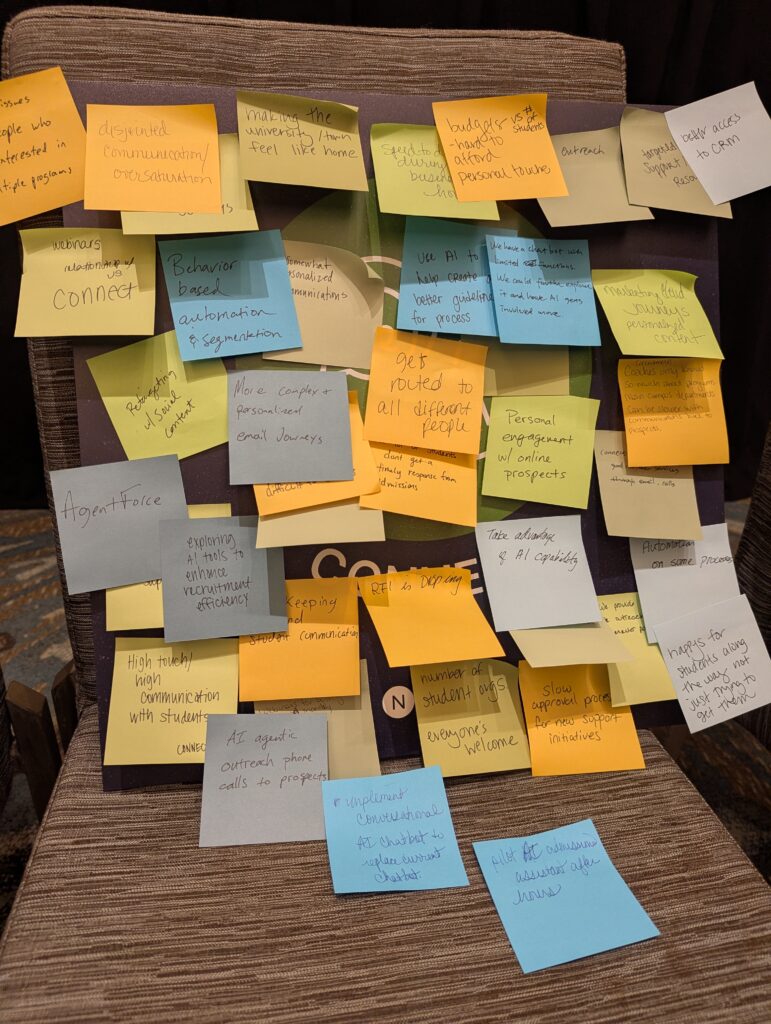
Post-its in this stage clustered around responsiveness. Teams noted high communication expectations, slow routing, and fragmented advising that leaves prospects unsure where to go.
Across Brags and Zags, participants pointed to opportunities in AI-assisted segmentation, conversational triage, better inquiry routing, and clearer handoffs. The sentiment wasn’t that AI replaces human connection, but that it helps institutions deliver the timely, guided interactions prospective learners expect.
Decide: The enrollment moment is clogged with friction—but solvable friction.
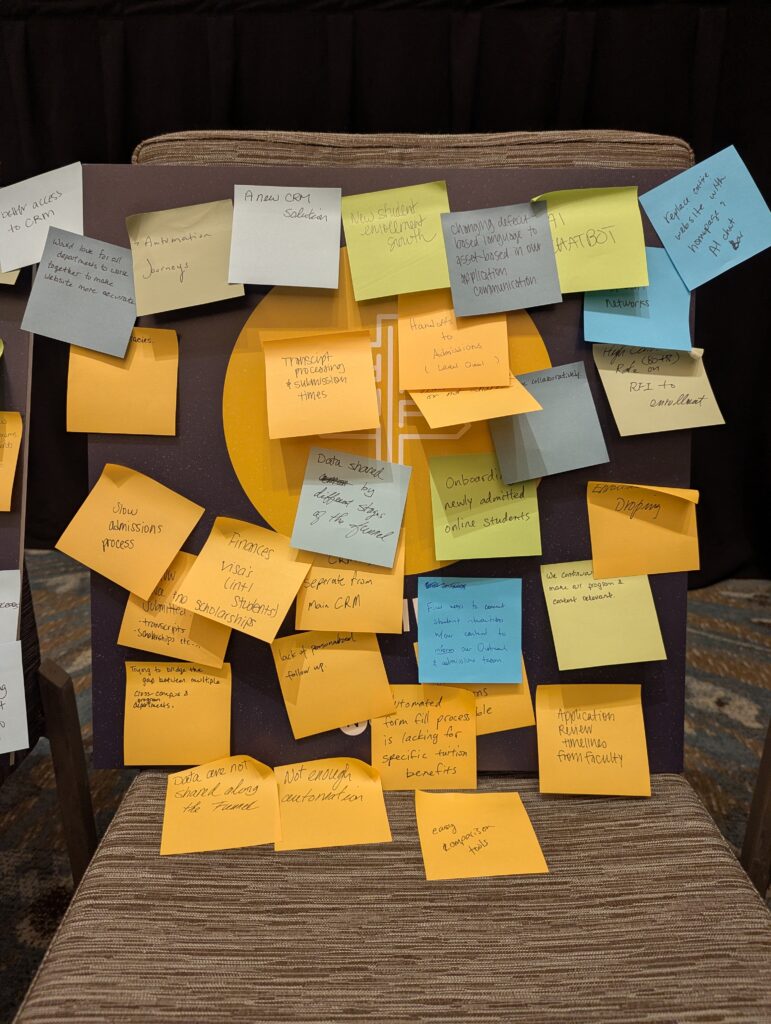
Participants acknowledged bottlenecks they’ve lived with for years: slow approvals, unclear requirements, inconsistent communication to admitted learners, and misaligned messaging across academic units.
Yet the Brags reflected real momentum—more structured nudges, clearer timelines, and early experiments with AI for inquiry follow-up. The takeaway: enrollment teams aren’t short on strategy—they’re short on capacity. AI can help them finally scale the counseling and clarity they already know works.
Learn: The teaching and support ecosystems still feel disconnected from the outreach ecosystem.
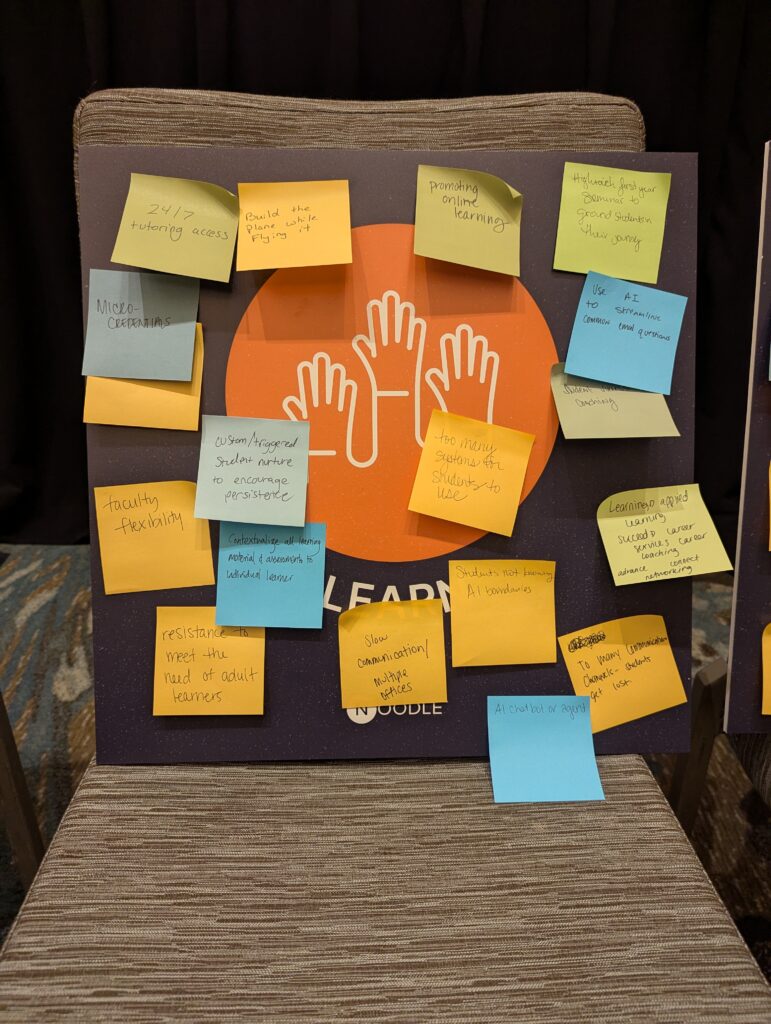
Once learners enter the classroom, gaps appear between what recruitment promises and what learners actually experience. Participants highlighted difficulty navigating support services, inconsistent cross-department communication, and limited visibility into where learners struggle.
Still, the Brags showed strong investment in advising, LMS-based alerts, and faculty openness to new tools. Many Zags imagined companion-style AI agents that could help learners move seamlessly across courses, policies, and systems—supporting consistency without requiring staff to be everywhere at once.
Succeed: Institutions want to be proactive… but are still too reactive.
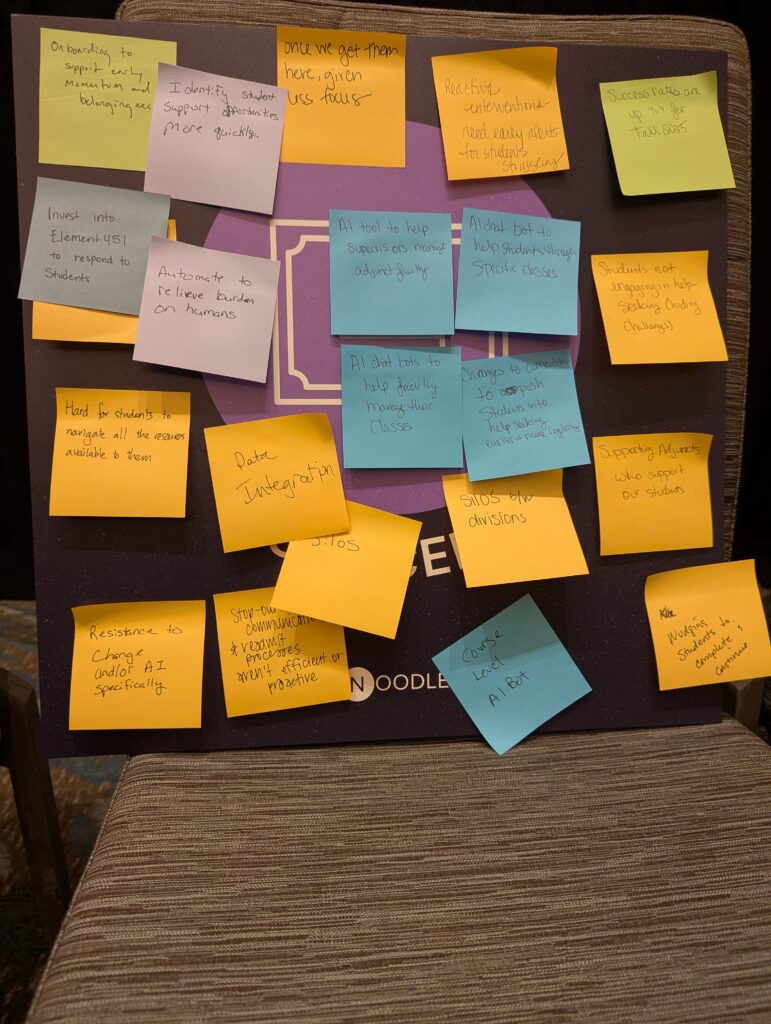
Student success teams repeatedly shared the same challenge: they know the early signals of risk, but often lack the tools or data structures to act on them quickly.
Drags included slow initiative approval, limited data access, and high-touch models that are increasingly hard to sustain. Yet the Zags were ambitious—more predictive nudging, integrated alerts, and AI-enabled outreach tied to milestones, moments, and behaviors. Participants didn’t view AI as a shortcut, but as the only scalable path to the level of responsiveness they aspire to deliver.
Advance: Institutions want lifelong learners… but are not designed for lifelong relationships.
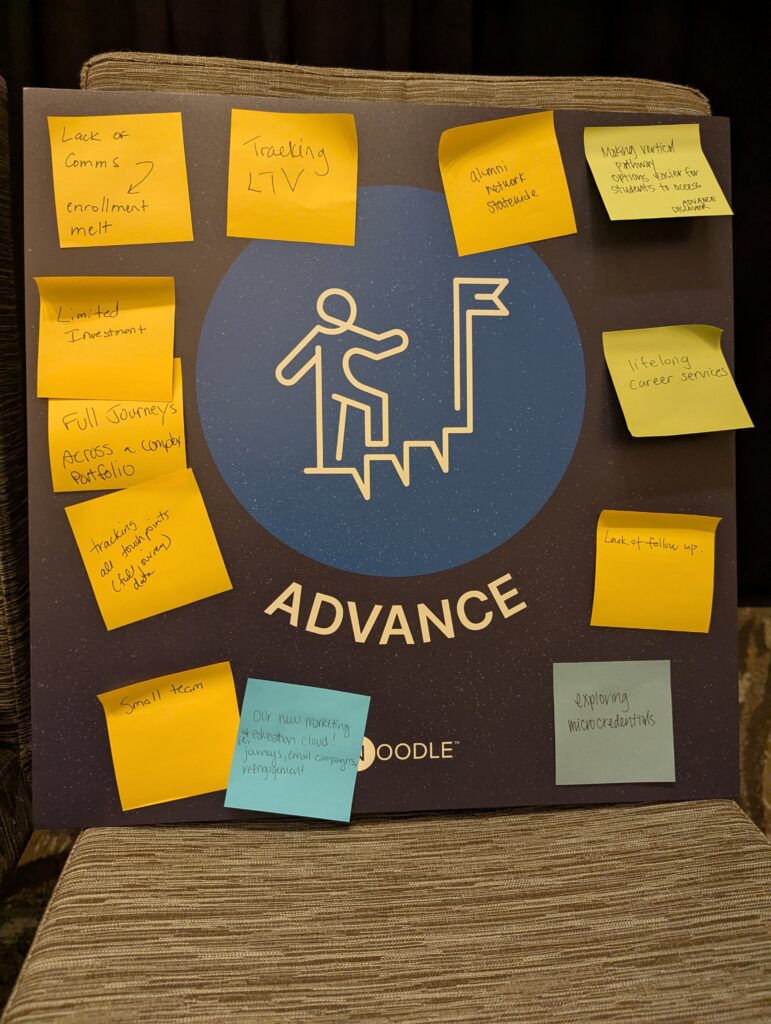
In this final stage, the conversation expanded from operations to long-term strategy. Participants aspire to build lifelong learning ecosystems, yet current models default to “relationship fades after graduation.”
Drags included limited follow-up, small advancement teams, episodic alumni communication, and almost no visibility across learners’ evolving needs. But the Zags were forward-looking: career-long agents, personalized alumni pathways, nudges tied to skill gaps, multi-year marketing journeys, and microcredential routes that support re-engagement.
The appetite for long-term connection is strong. What’s missing is the infrastructure to sustain it.
The emerging picture of a more connected learner experience
The Post-its weren’t just lists of challenges—they were markers of readiness. Across roles and institutions, participants described a future that feels within reach if systems evolve to support it.
Three themes rose to the surface:
- Connection is becoming the differentiator. Institutions making progress are linking data, communication, and continuity from first click through alumnihood.
- Expertise isn’t the issue; integration is. Teams know where friction lives, but lack the connective systems to address it across the journey.
- AI is viewed as capacity-building, not displacement. Participants consistently framed it as a way to expand human support in the moments that matter.
What this session ultimately revealed is not a sector overwhelmed by AI, but one actively looking for ways to make the learner journey more seamless, responsive, and human. The universal desire for connectedness was clear, and thoughtful AI, especially when embedded across the lifecycle, has a meaningful role to play. Connectedness must happen with or without AI, but the emerging concept of “connected AI” shows how technology can make it easier, more consistent, and more scalable.
If you’re exploring opportunities to create a more connected learner experience at your university, our experts would love to help. Get in touch to start a conversation about what’s possible.